Catalogue et risque des tools
Les tools sont les capacités explicitement accordées aux activités d’un Agent. Leur catalogue est indépendant des nodes de processus : chaque tool possède un contrat conçu pour l’usage agentique, un périmètre d’autorité et un niveau de risque statique.
Un tool n’est pas un node de processus
Un node est conçu pour être configuré et relié dans un graphe déterministe. Un tool est conçu pour être découvert et appelé par un Agent pendant un Run. Les deux interfaces peuvent réutiliser les mêmes règles et services métier, mais elles n’ont aucune obligation d’avoir la même granularité, les mêmes paramètres ou les mêmes sorties.
| Node de processus | Tool d’Agent |
|---|---|
| Optimisé pour les bindings, routes et garanties du graphe. | Optimisé pour une intention claire et des arguments qu’un Agent peut produire de façon fiable. |
| Peut exposer des variantes destinées à la composition déterministe. | Peut regrouper une intention lorsque les variantes de graphe n’apportent rien à l’Agent. |
| Ajouter un node enrichit le catalogue Process. | Un tool n’existe que s’il est explicitement conçu et publié dans le catalogue Agent. |
Le niveau de risque décrit la conséquence maximale
Chaque tool déclare obligatoirement un risk_level statique. Le niveau est déterminé par la conséquence métier maximale permise par son contrat, pas par les valeurs particulières d’un appel.
| Niveau | Interprétation | Exemples typiques |
|---|---|---|
low | Lecture, recherche, résolution ou calcul sans conséquence métier durable significative. | Lire une ressource, rechercher, vérifier une appartenance, proposer un calcul. |
medium | Mutation récupérable, préparatoire ou disposant d’une compensation canonique. | Créer un brouillon, suspendre une ressource réactivable, préparer une instruction annulable. |
high | Engagement externe, décision terminale ou effet difficile à annuler une fois exécuté. | Finaliser une décision, confirmer un engagement ou produire un effet externe irréversible. |
high n’accorde donc aucun droit supplémentaire et ne signifie pas qu’une donnée est sensible.Le niveau est aujourd’hui descriptif et visible à l’authoring. Il ne déclenche pas à lui seul une confirmation automatique ; des politiques de délégation plus strictes pourront s’appuyer dessus sans changer le contrat d’autorité du tool.
Une activité sélectionne et configure explicitement ses tools
Seuls les tools présents sur l’activité sélectionnée sont découvrables et appelables pendant le Run. Le processus appelant ne peut ni ajouter ni retirer un tool d’une révision Agent déjà pinnée.
Pour chaque paramètre prévu par le contrat, le designer peut imposer une valeur depuis un input de l’activité, une valeur fixe ou une ressource gouvernée lorsque ces sources sont autorisées. Un paramètre compatible laissé non configuré peut rester à la décision de l’Agent. Les paramètres réservés au designer ne deviennent jamais libres par omission.
Les résultats d’un tool restent projected par défaut pour les données protégées. Une demande raw est déclarée sur la configuration du tool dans l’activité et reste soumise aux consentements applicables. Voir Activités, tools et autorité et Protection des données.
Catalogue Core Agent
Ce catalogue présente actuellement 90 tools Core : 48 à risque faible, 25 à risque moyen et 17 à risque élevé.
Risque faible · 48
Lecture, recherche, résolution ou calcul sans conséquence métier durable significative.
| Tool | Intention |
|---|---|
check_company_group_membership | Check whether a visible Company belongs to a visible Company Group. |
fetch_checkout_session | Load the current canonical checkout session from a visible Ormuz reference. |
fetch_company | Load the current canonical company from a visible Ormuz reference. |
fetch_company_group | Load the current canonical company group from a visible Ormuz reference. |
fetch_compliance_check | Load the current canonical compliance check from a visible Ormuz reference. |
fetch_contact | Load the current canonical contact from a visible Ormuz reference. |
fetch_contact_role | Load the current canonical contact role from a visible Ormuz reference. |
fetch_credit_exposure | Load the current canonical credit exposure from a visible Ormuz reference. |
fetch_credit_limit | Load the current canonical credit limit from a visible Ormuz reference. |
fetch_dispute | Load the current canonical dispute from a visible Ormuz reference. |
fetch_due_date_schedule | Load the current canonical due date schedule from a visible Ormuz reference. |
fetch_invoice | Load the current canonical invoice from a visible Ormuz reference. |
fetch_invoice_balance | Compute the current payable balance observation for a visible Invoice. |
fetch_onboarding_case | Load the current canonical onboarding case from a visible Ormuz reference. |
fetch_order | Load the current canonical order from a visible Ormuz reference. |
fetch_payment | Load the current canonical payment from a visible Ormuz reference. |
fetch_payment_allocation | Load the current canonical payment allocation from a visible Ormuz reference. |
fetch_payment_term | Load the current canonical payment term from a visible Ormuz reference. |
fetch_psp_payment | Load the current canonical psp payment from a visible Ormuz reference. |
fetch_purchase_order | Load the current canonical purchase order from a visible Ormuz reference. |
fetch_receivable | Compute the current receivable observation for a visible Company. |
fetch_return | Load the current canonical return from a visible Ormuz reference. |
fetch_risk_score | Load the current canonical risk score from a visible Ormuz reference. |
fetch_supplier_invoice | Load the current canonical supplier invoice from a visible Ormuz reference. |
fetch_supplier_payment | Load the current canonical supplier payment from a visible Ormuz reference. |
get_company_groups | Retrieve the company groups linked to a visible Company. |
get_company_invoices | Retrieve the newest Invoices and credit notes for a visible buyer Company using bounded optional filters. |
get_company_orders | Retrieve the newest Orders for a visible buyer Company using bounded optional filters. |
get_contact_compliance_checks | Retrieve the compliance checks linked to a visible Contact. |
get_contact_roles | Retrieve the contact roles linked to a visible Company. |
get_contacts | Retrieve the contacts linked to a visible Company. |
get_invoice_disputes | Retrieve the disputes linked to a visible Invoice. |
get_invoice_orders | Retrieve every Order linked to a visible Invoice using a stable collection result. |
get_line_items | Retrieve line items from a visible Checkout Session, Order or Invoice. |
get_merchant_company | Return the Company representing the current merchant company. |
get_order_checkout_session | Retrieve the Checkout Session linked to a visible Order. |
get_order_invoices | Retrieve the invoices linked to a visible Order. |
get_order_returns | Retrieve the returns linked to a visible Order. |
get_psp_payments | Retrieve PSP payments linked to a visible Order or Invoice, optionally filtered by status. |
get_purchase_order_supplier_invoices | Retrieve the supplier invoices linked to a visible Purchase order. |
get_supplier_invoice_purchase_orders | Retrieve the purchase orders linked to a visible Supplier invoice. |
has_already_onboarded | Check whether a visible Company and optional contact already have approved and completed onboarding. |
has_valid_compliance_check | Evaluate fresh Compliance Checks for a visible Company or Contact using an explicit resolution strategy. |
propose_payment_allocation | Compute a bounded receivable-allocation proposal for a Company without committing reconciliation. |
read_file | Open a visible platform file so the model can inspect its content. |
resolve_contact | Select the best qualified contact for a Company using role and certification criteria. |
search_company | Search the current merchant for a Company using bounded business identity criteria. |
search_contacts | Search contacts of a visible Company using bounded contact criteria such as exact email or name text. |
Risque moyen · 25
Mutation récupérable, préparatoire ou disposant d’une compensation canonique.
| Tool | Intention |
|---|---|
attach_onboarding_subject | Attach a visible Company and/or Contact to an Onboarding Case using canonical subject validation. |
cancel_payment_refund | Cancel a visible bank/open-banking refund intent while no external cash movement has been established. |
cancel_supplier_payment | Cancel a visible supplier-payment instruction while it remains canonically cancellable before external execution. |
create_company | Create a canonical Company and optionally qualify it as buyer and/or supplier. |
create_contact | Create a contact on a visible Company without granting certified authority. |
create_contact_role | Create a declarative role for a visible Contact. Certification is a separate high-risk action. |
create_credit_note_draft | Create a persisted Credit Note proposal against a visible issued Invoice without issuing it. |
create_credit_note_payment_refunds | Create internal bank/non-PSP refund intents from visible issued credit notes without executing external cash movement. |
create_credit_note_psp_refunds | Create internal PSP refund intents for visible issued credit notes without executing provider cash movement. |
create_invoice_draft | Create a persisted Invoice proposal in draft state. This Tool does not issue the Invoice. |
create_psp_payment | Create an internal PSP payment intent in draft state; provider execution remains a separate action. |
create_return | Create a canonical Return from a visible Order. The current implementation requires a parent Process because creation starts the Return owner process. |
create_return_credit_note_drafts | Create persisted credit-note drafts from an explicit quantitative basis of a Return without issuing them. |
create_supplier_payment | Create a pending or scheduled Ormuz supplier-payment instruction without executing funds. |
dispute_supplier_invoice | Put a visible Supplier Invoice into its recoverable disputed state. |
mark_payment_unmatched | Durably classify a visible incoming Payment as unmatched when no business allocation can be retained. |
reactivate_company | Reactivate company through its canonical recoverable lifecycle transition. |
reactivate_contact | Reactivate contact through its canonical recoverable lifecycle transition. |
reconcile_payment | Apply a validated receivable-allocation proposal to a visible Payment or PSP Payment. The resulting application has an explicit reversal operation. |
refund_payment | Create an internal bank/open-banking refund intent linked to a visible Payment without executing external cash movement. |
refund_psp_payment | Create an internal PSP refund intent linked to a visible succeeded PSP Payment. This Tool does not execute provider cash movement. |
reverse_payment_allocation | Create the canonical mirror application that reverses a visible Payment Allocation without moving cash. |
suspend_company | Suspend company through its canonical recoverable lifecycle transition. |
suspend_contact | Suspend contact through its canonical recoverable lifecycle transition. |
update_dispute | Update the scope or claim data of an open Dispute without resolving it. |
Risque élevé · 17
Engagement externe, décision terminale ou effet difficile à annuler une fois exécuté.
| Tool | Intention |
|---|---|
approve_purchase_order | Approve a visible Purchase Order as a commercial and financial commitment. |
approve_supplier_invoice | Approve a visible Supplier Invoice as a financial/accounting commitment. |
authorize_return | Commit the merchant to an authorized scope for a visible Return. The current implementation requires its parent Process. |
cancel_dispute | Apply the terminal administrative cancellation of a visible Dispute. The current implementation requires its parent Process. |
cancel_order | Cancel a visible Order as an externally meaningful lifecycle commitment. |
cancel_purchase_order | Cancel a visible Purchase Order as an externally meaningful lifecycle commitment. |
cancel_return | Apply the terminal administrative cancellation of a visible Return before known physical movement. The current implementation requires its parent Process. |
certify_contact_role | Certify a visible Contact role as trusted authority. |
confirm_order | Confirm a visible Order as a commercial commitment. |
finalize_checkout_session | Finalize the financial result and lifecycle state of a visible Checkout Session. |
finalize_dispute | Resolve a visible Dispute with a terminal commercial outcome. The current implementation requires its parent Process. |
finalize_onboarding_case | Apply the terminal approved/rejected decision to a visible Onboarding Case and optionally attach already-persisted subjects. This Tool never materializes drafts. |
finalize_return | Close a visible Return with its terminal commercial resolution. The current implementation requires its parent Process. |
resolve_supplier_invoice_dispute | Resolve a visible Supplier Invoice dispute and choose the resumed business state. |
revoke_contact_role | Revoke a visible Contact role and its trusted authority. |
send_email | Send a transactional email through the email configuration selected by the activity designer. |
send_message | Send one prepared text message through the messaging configuration selected by the activity designer. |
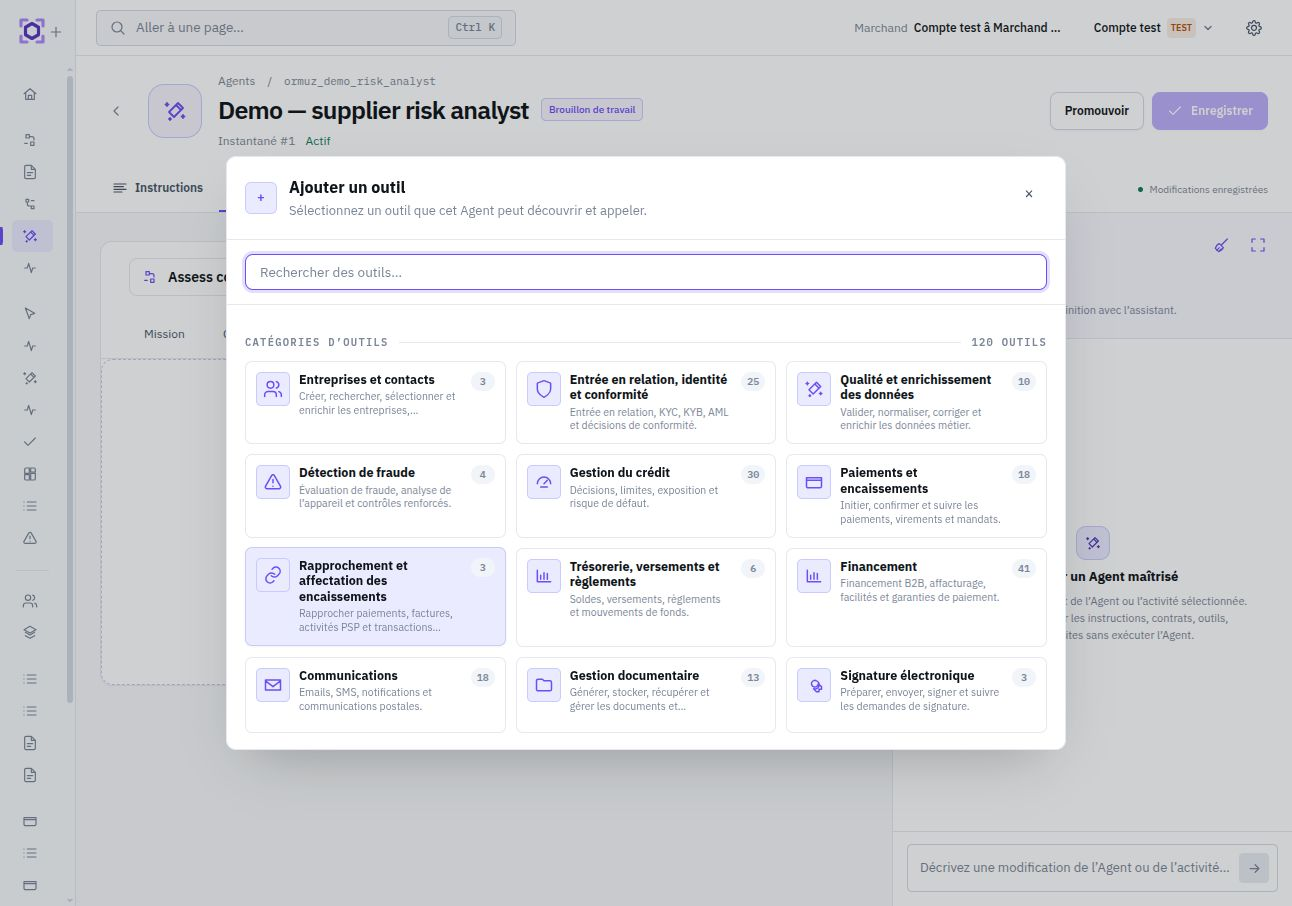
Les extensions publient leurs propres tools explicitement
Une extension installée peut proposer des tools supplémentaires, mais une capacité provider disponible techniquement n’est jamais publiée automatiquement aux Agents. Chaque tool d’extension doit disposer de son propre contrat agentique, de son niveau de risque et de ses exigences d’autorité.
Les extensions proposent actuellement 105 tools d’extension. Les détails provider-spécifiques appartiennent aux pages de l’intégration concernée plutôt qu’à ce catalogue Core générique.
Voir Intégrations pour les capacités propres à chaque extension.