Buyer credit management
Combine several limit sources, calculate capacity actually available for a sale, then trace every grant, consumption, reversal, release, or settlement in the company's credit exposure.
Business objective
Credit management is not just one “limit” number. Ormuz separates the limit policy, the effective limit calculated at a point in time, the exposure already committed, and the capacity decision made for a specific operation.
The process decides when a credit request should be approved. The credit_exposure then records actual movements of granted, consumed, released, or settled capacity so the history remains explicit.
Four concepts not to confuse
| Notion | Question | Object / output |
|---|---|---|
| Credit limit | Which limits are declared for this company, this currency, and this tax basis? | credit_limit |
| Effective limit | How should still-applicable limits be combined today? | effective_credit_limit |
| Exposure | What capacity has already been granted, consumed, released, or settled? | credit_exposure |
| Capacity check | Does the current request fit within available capacity? | credit_availability_check |
Credit journey
The capacity decision precedes the grant. Subsequent movements evolve exposure without rewriting the history of earlier movements.
For a simple journey, credit.evaluate_credit_availability
combines effective-limit resolution, exposure reading, and the approved/rejected decision. Separate nodes remain useful when your process needs to inspect or alter each step.
1. Define and resolve limits
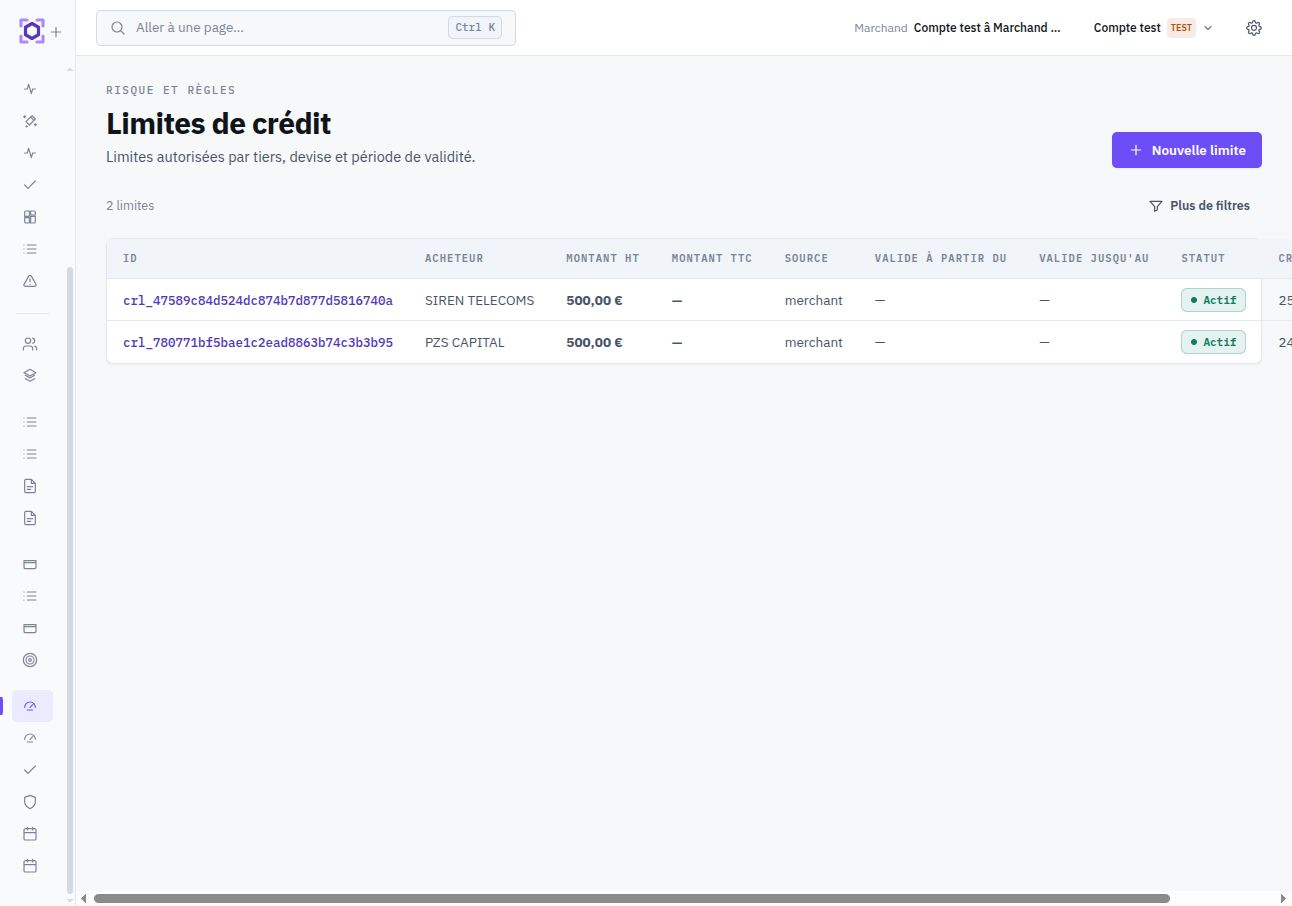
Create applicable policies with credit.add_credit_limit. A limit carries a currency, an excluding_tax or including_tax basis, validity period, and source — for example the merchant, a credit insurer, or a BNPL provider.
credit.fetch_effective_credit_limit first filters active limits valid on the requested date, then applies the selected strategy:
| Strategy | Effect | Typical use |
|---|---|---|
maximum | Keeps the highest applicable limit. | Several alternative sources, one retained capacity. |
minimum | Keeps the most conservative. | Policy where the most restrictive source wins. |
cumulative | Adds the applicable limits. | Explicitly cumulative complementary capacities. |
2. Evaluate available capacity
credit.check_credit_availability compares an effective limit, current exposure, and requested amount. It routes to approved or rejected and produces an explicit check object that you can retain in process context.
If the result is favorable and business policy genuinely authorizes the operation, use
credit.grant_credit. The grant creates a movement credit_granted
and returns its movement identifier, which can then be linked to consumption, release, or settlement movements for better traceability.
It answers one request, point in time, currency, and basis. When commercial conditions change, recalculating capacity is preferable to blindly reusing an old result.
3. Evolve exposure
| Business fact | Node | Movement |
|---|---|---|
| A sale consumes credit | credit.consume_credit_exposure | credit_consumed |
| A consumption must be reversed | credit.reverse_credit_consumption | credit_consumption_reversed |
| An unused authorization is released | credit.release_credit_exposure | credit_released |
| A covered receivable is settled | credit.settle_credit_exposure | credit_settled |
| Remaining exposure is canceled | credit.cancel_credit_exposure | credit_cancelled |
Movements are appended; they do not rewrite previous facts. A reversal references a precise movement credit_consumed and may be partial, but cumulative reversals cannot exceed the original consumption.
Overconsumption: record before correcting
Consumption from a reliable business fact may exceed prior authorization. Ormuz records the movement instead of rejecting the fact, then makes the anomaly observable through credit_exposure.overconsumed when the threshold is crossed.
The ledger represents what happened. Overconsumption must trigger your risk-handling process; it must not be corrected by artificially reducing consumption or rewriting past authorization.
Checklist
- Keep excluding-tax/including-tax basis and currency consistent across limits, capacity, and exposure.
- Explicitly choose the limit-combination strategy.
- Recalculate capacity at the time of an important decision.
- Create a movement
credit_grantedonly after a favorable business decision. - Consume credit from the business fact that actually materializes the commitment.
- Reference the authorization movement when this transactional traceability is known.
- Use a reversal instead of modifying past consumption.
- Treat
credit_exposure.overconsumedas an observable business incident.