Tool catalog and risk
Tools are capabilities explicitly granted to an Agent activity. Their catalog is independent from process nodes: each tool has a contract designed for agentic use, a scope of authority, and a static risk level.
A tool is not a process node
A node is designed to be configured and connected in a deterministic graph. A tool is designed to be discovered and called by an Agent during a Run. Both interfaces may reuse the same business rules and services, but they do not have to share the same granularity, parameters, or outputs.
| Process node | Tool d’Agent |
|---|---|
| Optimized for bindings, routes, and graph guarantees. | Optimized for a clear intent and arguments an Agent can produce reliably. |
| May expose variants intended for deterministic composition. | May group one intent when graph variants add no value for the Agent. |
| Adding a node enriches the Process catalog. | A tool exists only when it is explicitly designed and published in the Agent catalog. |
The presence of an operation in Process Builder does not mean an Agent can call it. Conversely, an agentic need may justify a tool without creating an artificial node.
Risk level describes the maximum consequence
Every tool must declare a risk_level static risk level. The level is determined by the maximum business consequence allowed by its contract, not by the specific values of one call.
| Level | Interpretation | Typical examples |
|---|---|---|
low | Reading, search, resolution, or calculation without durable business consequence. | Read a resource, search, check membership, or propose a calculation. |
medium | Recoverable or preparatory mutation, or one with a canonical compensation mechanism. | Create a draft, suspend a reactivatable resource, or prepare a cancelable instruction. |
high | External commitment, terminal decision, or effect that is difficult to reverse once executed. | Finalize a decision, confirm a commitment, or produce an irreversible external effect. |
The effective call is validated against both the tool contract and activity configuration. An activity can therefore expose the same tool with a narrower parameter surface than another activity.
This is how one Agent can have separate analysis and execution activities with different authority.
Parameter source is part of the activity revision.
Changing it produces a new Agent revision.
The designer can source a value from an activity input, a fixed value, or a governed resource when those sources are allowed. A compatible parameter left unconfigured may remain at the Agent's discretion. Designer-only parameters never become free merely by omission.
Tool results remain projected by default for protected data. A raw request is declared on the tool configuration in the activity and remains subject to applicable consents. See Activities, tools, and authority and Data protection.
Catalogue Core Agent
This catalog currently presents 90 tools Core : 48 low-risk, 25 medium-risk, and 17 high-risk tools.
Low risk · 48
Reading, search, resolution, or calculation without durable business consequence.
| Tool | Intention |
|---|---|
check_company_group_membership | Check whether a visible Company belongs to a visible Company Group. |
fetch_checkout_session | Load the current canonical checkout session from a visible Ormuz reference. |
fetch_company | Load the current canonical company from a visible Ormuz reference. |
fetch_company_group | Load the current canonical company group from a visible Ormuz reference. |
fetch_compliance_check | Load the current canonical compliance check from a visible Ormuz reference. |
fetch_contact | Load the current canonical contact from a visible Ormuz reference. |
fetch_contact_role | Load the current canonical contact role from a visible Ormuz reference. |
fetch_credit_exposure | Load the current canonical credit exposure from a visible Ormuz reference. |
fetch_credit_limit | Load the current canonical credit limit from a visible Ormuz reference. |
fetch_dispute | Load the current canonical dispute from a visible Ormuz reference. |
fetch_due_date_schedule | Load the current canonical due date schedule from a visible Ormuz reference. |
fetch_invoice | Load the current canonical invoice from a visible Ormuz reference. |
fetch_invoice_balance | Compute the current payable balance observation for a visible Invoice. |
fetch_onboarding_case | Load the current canonical onboarding case from a visible Ormuz reference. |
fetch_order | Load the current canonical order from a visible Ormuz reference. |
fetch_payment | Load the current canonical payment from a visible Ormuz reference. |
fetch_payment_allocation | Load the current canonical payment allocation from a visible Ormuz reference. |
fetch_payment_term | Load the current canonical payment term from a visible Ormuz reference. |
fetch_psp_payment | Load the current canonical psp payment from a visible Ormuz reference. |
fetch_purchase_order | Load the current canonical purchase order from a visible Ormuz reference. |
fetch_receivable | Compute the current receivable observation for a visible Company. |
fetch_return | Load the current canonical return from a visible Ormuz reference. |
fetch_risk_score | Load the current canonical risk score from a visible Ormuz reference. |
fetch_supplier_invoice | Load the current canonical supplier invoice from a visible Ormuz reference. |
fetch_supplier_payment | Load the current canonical supplier payment from a visible Ormuz reference. |
get_company_groups | Retrieve the company groups linked to a visible Company. |
get_company_invoices | Retrieve the newest Invoices and credit notes for a visible buyer Company using bounded optional filters. |
get_company_orders | Retrieve the newest Orders for a visible buyer Company using bounded optional filters. |
get_contact_compliance_checks | Retrieve the compliance checks linked to a visible Contact. |
get_contact_roles | Retrieve the contact roles linked to a visible Company. |
get_contacts | Retrieve the contacts linked to a visible Company. |
get_invoice_disputes | Retrieve the disputes linked to a visible Invoice. |
get_invoice_orders | Retrieve every Order linked to a visible Invoice using a stable collection result. |
get_line_items | Retrieve line items from a visible Checkout Session, Order or Invoice. |
get_merchant_company | Return the Company representing the current merchant company. |
get_order_checkout_session | Retrieve the Checkout Session linked to a visible Order. |
get_order_invoices | Retrieve the invoices linked to a visible Order. |
get_order_returns | Retrieve the returns linked to a visible Order. |
get_psp_payments | Retrieve PSP payments linked to a visible Order or Invoice, optionally filtered by status. |
get_purchase_order_supplier_invoices | Retrieve the supplier invoices linked to a visible Purchase order. |
get_supplier_invoice_purchase_orders | Retrieve the purchase orders linked to a visible Supplier invoice. |
has_already_onboarded | Check whether a visible Company and optional contact already have approved and completed onboarding. |
has_valid_compliance_check | Evaluate fresh Compliance Checks for a visible Company or Contact using an explicit resolution strategy. |
propose_payment_allocation | Compute a bounded receivable-allocation proposal for a Company without committing reconciliation. |
read_file | Open a visible platform file so the model can inspect its content. |
resolve_contact | Select the best qualified contact for a Company using role and certification criteria. |
search_company | Search the current merchant for a Company using bounded business identity criteria. |
search_contacts | Search contacts of a visible Company using bounded contact criteria such as exact email or name text. |
Medium risk · 25
Recoverable or preparatory mutation, or one with a canonical compensation mechanism.
| Tool | Intention |
|---|---|
attach_onboarding_subject | Attach a visible Company and/or Contact to an Onboarding Case using canonical subject validation. |
cancel_payment_refund | Cancel a visible bank/open-banking refund intent while no external cash movement has been established. |
cancel_supplier_payment | Cancel a visible supplier-payment instruction while it remains canonically cancellable before external execution. |
create_company | Create a canonical Company and optionally qualify it as buyer and/or supplier. |
create_contact | Create a contact on a visible Company without granting certified authority. |
create_contact_role | Create a declarative role for a visible Contact. Certification is a separate high-risk action. |
create_credit_note_draft | Create a persisted Credit Note proposal against a visible issued Invoice without issuing it. |
create_credit_note_payment_refunds | Create internal bank/non-PSP refund intents from visible issued credit notes without executing external cash movement. |
create_credit_note_psp_refunds | Create internal PSP refund intents for visible issued credit notes without executing provider cash movement. |
create_invoice_draft | Create a persisted Invoice proposal in draft state. This Tool does not issue the Invoice. |
create_psp_payment | Create an internal PSP payment intent in draft state; provider execution remains a separate action. |
create_return | Create a canonical Return from a visible Order. The current implementation requires a parent Process because creation starts the Return owner process. |
create_return_credit_note_drafts | Create persisted credit-note drafts from an explicit quantitative basis of a Return without issuing them. |
create_supplier_payment | Create a pending or scheduled Ormuz supplier-payment instruction without executing funds. |
dispute_supplier_invoice | Put a visible Supplier Invoice into its recoverable disputed state. |
mark_payment_unmatched | Durably classify a visible incoming Payment as unmatched when no business allocation can be retained. |
reactivate_company | Reactivate company through its canonical recoverable lifecycle transition. |
reactivate_contact | Reactivate contact through its canonical recoverable lifecycle transition. |
reconcile_payment | Apply a validated receivable-allocation proposal to a visible Payment or PSP Payment. The resulting application has an explicit reversal operation. |
refund_payment | Create an internal bank/open-banking refund intent linked to a visible Payment without executing external cash movement. |
refund_psp_payment | Create an internal PSP refund intent linked to a visible succeeded PSP Payment. This Tool does not execute provider cash movement. |
reverse_payment_allocation | Create the canonical mirror application that reverses a visible Payment Allocation without moving cash. |
suspend_company | Suspend company through its canonical recoverable lifecycle transition. |
suspend_contact | Suspend contact through its canonical recoverable lifecycle transition. |
update_dispute | Update the scope or claim data of an open Dispute without resolving it. |
High risk · 17
External commitment, terminal decision, or effect that is difficult to reverse once executed.
| Tool | Intention |
|---|---|
approve_purchase_order | Approve a visible Purchase Order as a commercial and financial commitment. |
approve_supplier_invoice | Approve a visible Supplier Invoice as a financial/accounting commitment. |
authorize_return | Commit the merchant to an authorized scope for a visible Return. The current implementation requires its parent Process. |
cancel_dispute | Apply the terminal administrative cancellation of a visible Dispute. The current implementation requires its parent Process. |
cancel_order | Cancel a visible Order as an externally meaningful lifecycle commitment. |
cancel_purchase_order | Cancel a visible Purchase Order as an externally meaningful lifecycle commitment. |
cancel_return | Apply the terminal administrative cancellation of a visible Return before known physical movement. The current implementation requires its parent Process. |
certify_contact_role | Certify a visible Contact role as trusted authority. |
confirm_order | Confirm a visible Order as a commercial commitment. |
finalize_checkout_session | Finalize the financial result and lifecycle state of a visible Checkout Session. |
finalize_dispute | Resolve a visible Dispute with a terminal commercial outcome. The current implementation requires its parent Process. |
finalize_onboarding_case | Apply the terminal approved/rejected decision to a visible Onboarding Case and optionally attach already-persisted subjects. This Tool never materializes drafts. |
finalize_return | Close a visible Return with its terminal commercial resolution. The current implementation requires its parent Process. |
resolve_supplier_invoice_dispute | Resolve a visible Supplier Invoice dispute and choose the resumed business state. |
revoke_contact_role | Revoke a visible Contact role and its trusted authority. |
send_email | Send a transactional email through the email configuration selected by the activity designer. |
send_message | Send one prepared text message through the messaging configuration selected by the activity designer. |
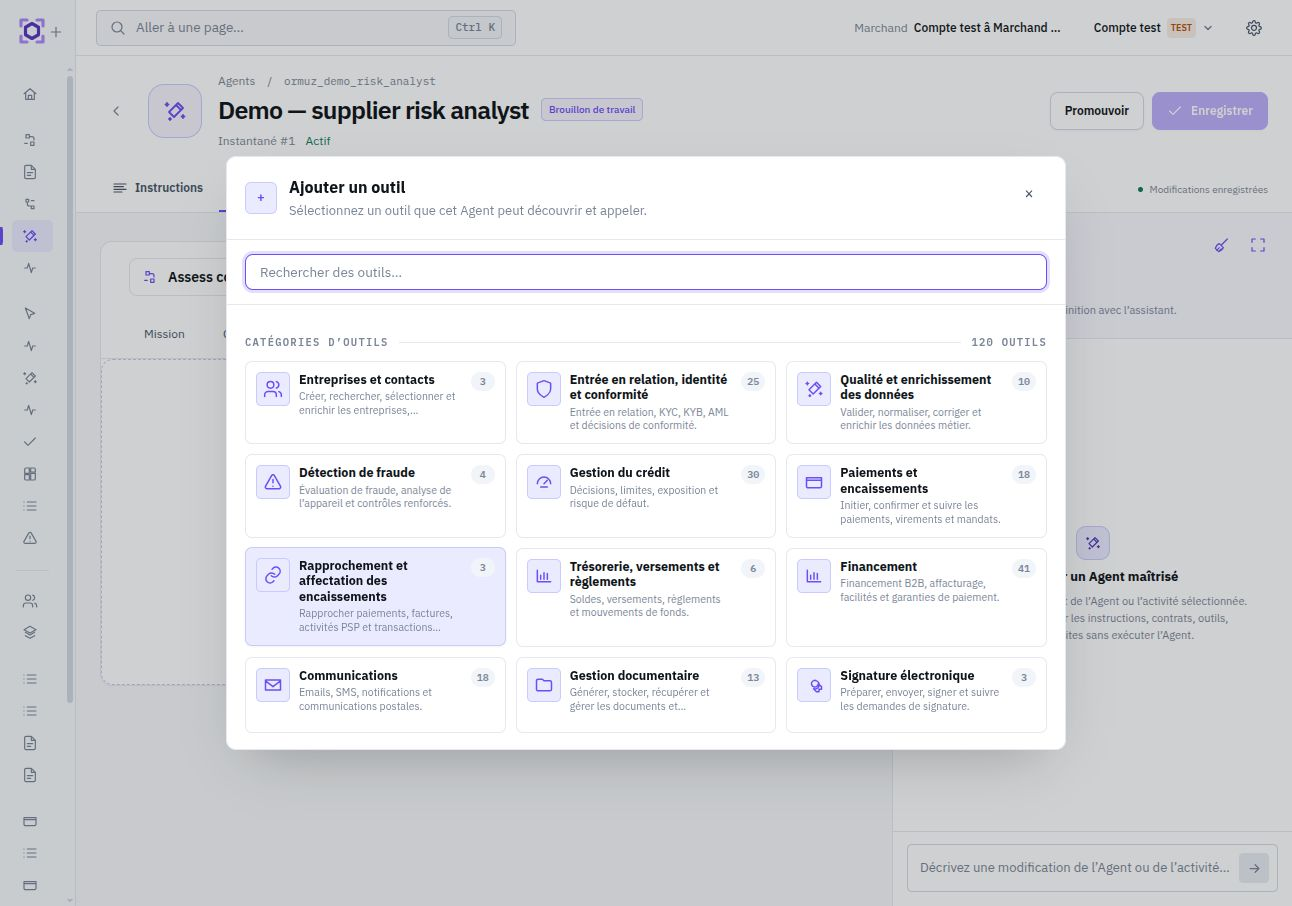
Extensions explicitly publish their own tools
An installed extension may offer additional tools, but a provider capability that is technically available is never automatically published to Agents. Each extension tool must have its own agentic contract, risk level, and authority requirements.
Extensions currently provide 105 extension tools. Provider-specific details belong on the relevant integration pages rather than in this generic Core catalog.
See Integrations for capabilities specific to each extension.