Definitions, revisions, and instances
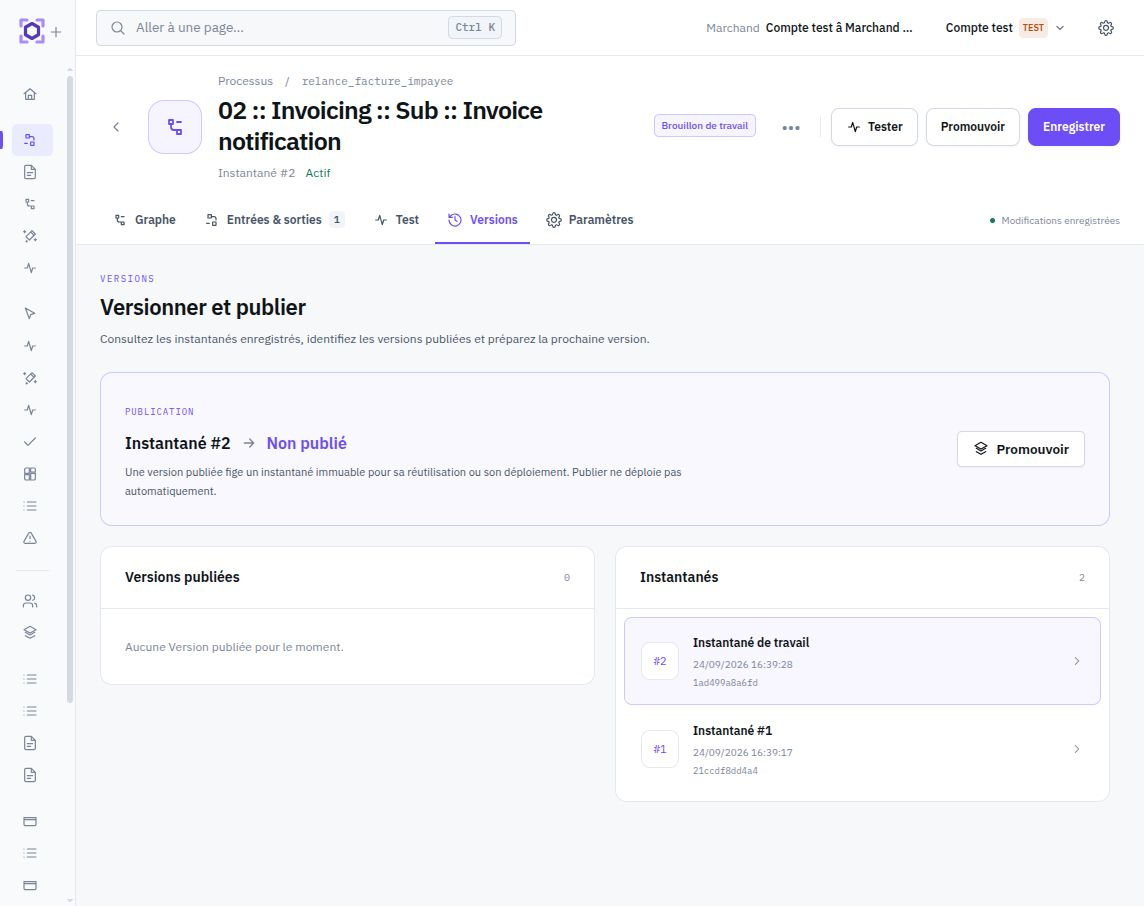
A process definition carries the durable identity of your process. Its working state points to an immutable revision, a Release explicitly marks a published revision, and every instance preserves the exact revision it executes. These layers let you change the future without rewriting execution history.
For the shared contract across deployable artifacts — Working, snapshots, Releases, live deployment, and retention — see Versions, Releases, and deployment.
Process definition
The definition is the durable identity. Working selects the snapshot currently being edited; a Release publishes a snapshot; an instance executes one precise snapshot.
A process_definition is identified by an prd_…ID. Its executable content notably includes the input schema, output schema, graph, hosted-experience configuration, and associated launchers.
input_schemadefines what the instance accepts at startup.flow_configdescribes nodes, their parameters, and graph edges.output_schemadefines the values produced on completion.activeallows or prevents creation of new instances from the definition.
Working and immutable revisions
The definition exposes working_revision_id and revision_number. The Working pointer designates the snapshot currently selected by the editor and by new launches of this definition. The snapshot itself is an immutable revision identified by pdr_….
When a save genuinely changes executable content, Ormuz calculates a new
content_hash and creates a newly numbered revision. When executable content is identical, the existing snapshot is reused instead of producing an artificial revision.
A revision captures the contract required for reproducible execution: inputs, outputs, graph, environment dependencies, User Journey, and launcher snapshot. Agent and Decision dependencies used by the process are also resolved at revision level.
Editing the process does not rewrite pdr_42 : a new revision is created and the definition moves its working_revision_id. An already-created instance therefore continues executing its original snapshot.
Releases: explicitly publish a revision
A process_definition_release (prl_…) is a publication milestone referencing one precise revision. It has its own release_number and preserves the hash of published content. Publishing without specifying a revision promotes the current Working snapshot.
The same revision is not published twice as two distinct Releases: another promotion request for the same snapshot resolves the existing Release. A definition also preserves its latest published milestone separately from its Working pointer.
Working answers “which snapshot am I editing / executing now?”. A Release answers “which snapshot did I explicitly publish as a milestone?”. Publishing does not allow retroactive modification of an existing Release.
Subprocess revisions
A subprocess or Foreach node chooses how it references the child definition. The current contract exposes two modes: working and pinned.
| Mode | Behavior | Usage |
|---|---|---|
working | The child definition's Working revision is resolved when the child is launched. | Design and test when parent and child should evolve together. |
pinned | The node explicitly preserves the child revision ID to execute. | Reproducible contract and controlled deployment. |
A child instance always remains attached to the revision actually selected when it was created. Live accounts do not accept a child reference working in a process revision: deployment must freeze dependencies to precise revisions.
See Subworkflow for the complete parent/child contract.
Instances
A process_instance (pci_…) represents a concrete execution. It retains the
process_definition_id, the process_definition_revision snapshot used, its input, current state, optional output, and start provenance.
Current public states are:
running— active execution;waiting— waiting for a timer, interaction, event, or child;stopping— stop requested while execution still needs to yield;completed— output contract produced successfully;failed— terminal failure of this attempt;retry_exhausted— automatic retry budget exhausted;superseded— a corrective continuation replaced this attempt in the lineage;stopped— instance explicitly stopped.
The relationships retry_of, fork_of and parent_process_instance_id make lineage observable without mixing states of several instances. See
Observability and
Errors, retries, and idempotency.
Start source
start_source preserves instance provenance. Its structure depends on the operation that created it; do not treat it as a closed enum limited to a few historical values.
| Mode courant | Meaning |
|---|---|
api | Direct launch of the definition through `POST /v1/processes/:id/runs`. |
event | Event launcher; provenance notably preserves event type and launcher. |
subworkflow | Child instance created by a subprocess or Foreach node from a parent instance. |
retry | Corrective continuation of an existing instance. |
rerun | Voluntary new execution created from an earlier instance using current Working. |
fork | Corrective branch created from a precise point in a source instance. |
Event provenance may preserve event ID and type; subprocess provenance preserves parent context; retry, rerun, and fork preserve their relationship to the source instance. These values reconstruct why an execution exists, not modify its revision contract.
Instance output
A completed instance resolves its output_schema from authorized process sources. The persisted output belongs to the executed revision, not to a newer definition version.
For a waiting subprocess, this output becomes the parent node output when the child finishes. An empty output schema is valid for a terminal process that performs only business effects.
The sensitive and secret values preserve their protection in input, state, steps, and output. See Data protection.
Duplicate a process
POST /v1/processes/:id/duplicate creates a new definition with its own identity and history. Current executable content is copied; instances and revision history from the source definition are not.
copy_launchers is true by default, and the new definition is inactive by default. Permissions required by nodes must be explicitly granted in the copy context rather than assumed inherited from the source definition.
Activation
active controls creation of new instances from a definition. A direct launch of an inactive definition is rejected, and system-launcher resolution ignores inactive definitions.
Disabling a definition does not rewrite existing instances or their snapshot. Use this option to prevent new starts, not as a mechanism to retroactively stop running instances.
To interrupt an already-created execution, use the instance-stop mechanism. The definition flag changes only eligibility for new launches.